
Emergency slab leak: water coming up through the floor
Water appearing at the base of a wall, seeping through a concrete floor or pooling outside the foundation with no obvious source is treated as an emergency, because a pressurized supply line under a slab keeps flowing until it is shut off. Turn off the main valve at the house, switch off power to any wet area at the breaker, and call (954) 697-4920.
A technician confirms the leak with listening equipment before anything is cut, so the repair opens the smallest section of floor that fixes it. If the leak is on a hot water line, turning the water heater off after the supply is closed keeps it from heating an empty tank.
Why slab leaks are common in this specific area
A slab leak happens when a water line running under a home's concrete foundation develops a leak, usually from corrosion in cast-iron or galvanized pipe, or occasionally from ground shifting putting stress on a joint. Pompano Beach and its neighboring cities have a real concentration of homes built between the 1950s and 1970s with exactly this pipe material under the slab, which is why this is one of the more frequent calls across this coverage area.
Detection first, then the right repair method
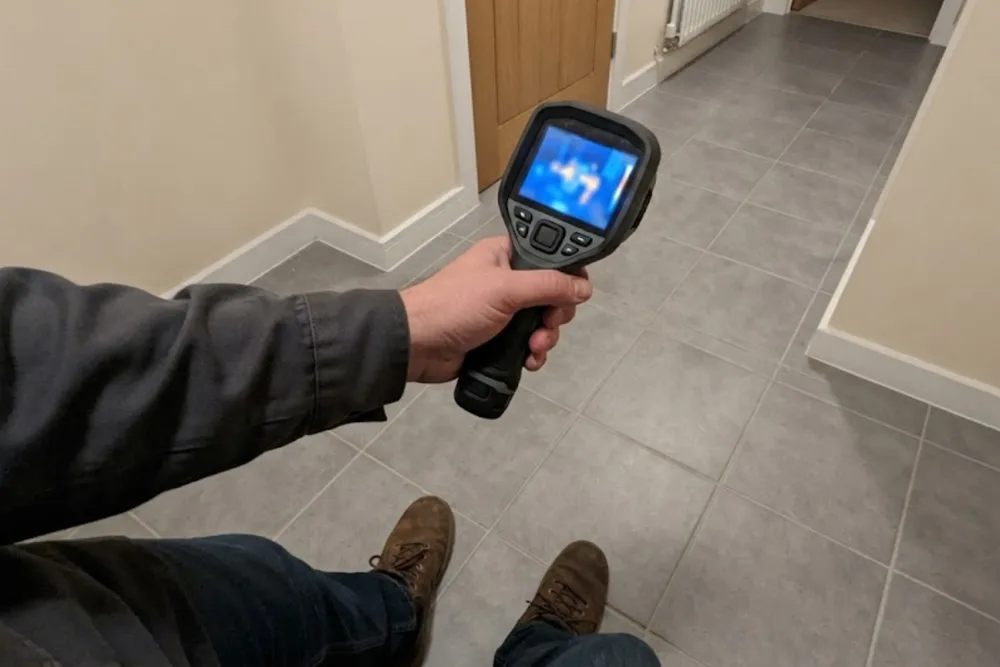
Acoustic listening equipment and thermal imaging locate the leak's approximate position without cutting into the floor first, which is what allows a repair to open one targeted section instead of a wide search area. Once located, the choice is usually between a direct repair at that spot or rerouting a new line above the slab to bypass the damaged section entirely, which is sometimes faster and less disruptive than breaking concrete.
If the leak is the first of what's likely to be several on an aging line, we'll say so directly, since a single patch on a line that's failing throughout is a short-term answer at best.
What to do before we arrive for a suspected slab leak
Shut off the main water valve if the leak is significant enough that waiting could cause more damage. Avoid repeatedly walking on visibly wet or warm flooring, since saturated subfloor can weaken. Note when the symptoms started and whether the water bill has changed, both useful details for the technician.
Documentation for insurance purposes
A slab leak claim often depends on how quickly the leak is documented and repaired, since insurance policies frequently distinguish between sudden, accidental water damage and gradual damage from a leak that went unaddressed. We provide a written diagnosis with the leak's location and likely cause, which is the kind of documentation most adjusters ask for when a claim involves a slab leak specifically.
This doesn't guarantee coverage, since policy language varies and we aren't in a position to interpret a specific policy's terms. What we can do is document the technical facts of the leak and repair accurately and promptly.
Why a single slab leak is rarely truly isolated on an old system
Cast-iron and galvanized pipe corrodes as a whole system, not at one random point, which means a confirmed leak at one location is a signal about the condition of the entire buried supply line, not just that one spot. We're direct about this pattern rather than treating each leak as an isolated, unrelated event, since that framing leads to a homeowner paying for repeated individual repairs on a line that was always going to need full replacement eventually.
Signs on the water bill and meter that point to the slab
A bill that doubles or triples, a meter that moves with everything off, or a hot water line that runs warm at the tap when nobody has used it are the classic hints of a leak below the floor. A damp spot near the edge of the slab or along the garage foundation points the same way. Report each of these on the call so the technician arrives with the right equipment.
If the meter test points to the slab but you want to rule out the yard and the walls first, our leak detection page covers how those other locations are checked.