
Why cast-iron and galvanized pipe fails on its own schedule
Cast-iron drain and supply pipe corrodes from the inside, where it can't be seen, over roughly 40 to 50 years. Galvanized supply pipe follows a similar pattern but often fails sooner, closer to 30 to 50 years, as the zinc coating wears through and the steel underneath starts rusting from the inside out.
Pompano Beach's mid-century housing stock puts a meaningful share of homes right in that window now, concentrated in older neighborhoods like Pompano Beach Highlands, Palm Aire, and the streets around Old Pompano. The pipe doesn't announce itself failing. Water pressure drops gradually, the water bill creeps up with no visible leak, or rust-tinted water shows up at one fixture before others, and by the time there's a visible leak the pipe has usually been failing for a while already.
What a repiping actually involves
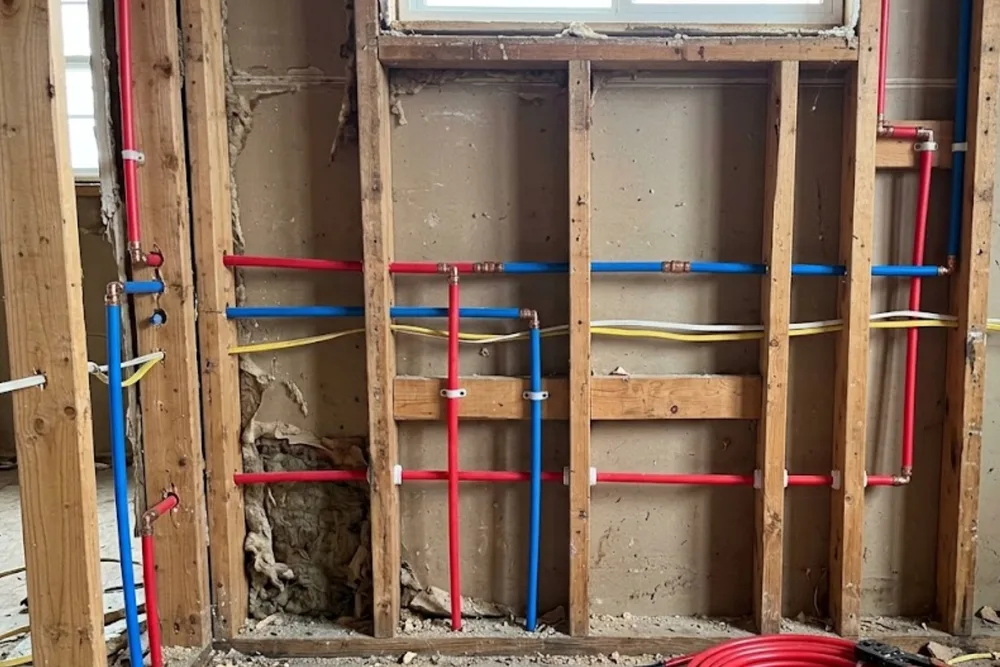
For a whole-home repipe, PEX is the more common choice now because it doesn't corrode and handles small ground shifts better than rigid copper, though copper is still the right call in some situations, particularly exposed runs. Either way, the job means opening a limited number of access points in walls or the slab, running new lines, and patching, not tearing out entire walls.
A partial repipe, limited to the sections showing the worst corrosion, is sometimes the more honest answer than a full whole-home job, especially if half the house was already updated at some point. We inspect and tell you which situation applies rather than defaulting to the bigger job.
| Material | Typical Lifespan | Corrodes? | Common In |
|---|---|---|---|
| Cast iron / galvanized (original) | 40-50 years | Yes, from inside out | Pre-1980 homes here |
| Copper | 50+ years | Rarely | Exposed runs, some repipes |
| PEX | 40-50+ years | No | Most repipes today |
How long a repipe takes and what happens to water service
A whole-home repipe on an average single-family home typically runs one to three days depending on the home's size and how the original lines were run. Water gets shut off during active work but is restored each evening, so it's rarely a multi-day stretch with no water at all.
Drywall access points get patched as part of the job, though texture-matching and paint are usually left for the homeowner's own painter, since matching an exact existing texture and color isn't something a plumbing crew is equipped to do well. We'll be upfront about where our work ends on that front before starting.
What happens to fixtures and finished walls during the job
Faucets, toilets, and other fixtures usually get disconnected and reset rather than replaced, since the fixtures themselves aren't what's failing in a repipe. If a fixture is already old enough that reconnecting it risks a leak on its own, we'll flag that separately rather than assume it should be swapped as part of the repiping cost.
For homes with tile, terrazzo, or another finished slab floor, we discuss the access-point plan before cutting anything, since terrazzo in particular is harder to patch invisibly than standard concrete or drywall. Knowing that going in avoids a surprise about floor patching after the fact.
What to do before you call about repiping
A few signs are worth checking for directly: rust-tinted water at more than one fixture, a noticeable and sustained drop in water pressure across the house rather than at just one tap, or a second pipe leak within a year of the first. Any one of these on a pre-1980 home is worth a call rather than waiting for a third repair.
If a leak is actively visible, shut off the main water valve before calling to limit damage while a repiping conversation gets sorted out.
Water service line replacement and old pipe questions
Some repiping calls are about the line between the meter and the house rather than the pipes inside. Replacing that line is a separate scope, and it is worth raising on the call so the visit is planned around the right pipe. If a home still has original galvanized pipe, or an older line of uncertain material, ask for the material to be identified before deciding.
Homes built before 1986 may also have lead solder at copper joints, since lead-free requirements came later. If that is a concern, ask the technician to look at the joints and explain what they see. For a single cracked section instead of a full replacement, general plumbing repair is usually the better fit.