
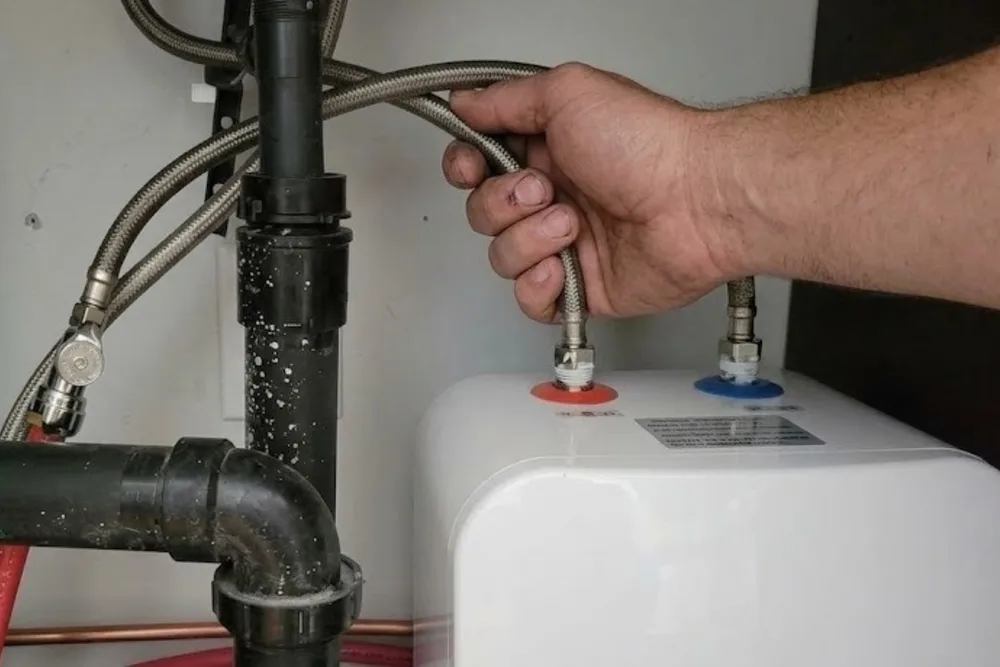
Emergency water heater replacement after a tank failure
When a tank has failed and the garage or closet is flooded, the first job is stopping the water and the second is getting hot water back. Shut off the cold supply to the heater and the power or gas, then call (954) 697-4920. We confirm the replacement unit, any permit and code items, and the price before work starts.
A same-day swap can often be arranged when the new unit matches the existing size, fuel type and venting. Changes such as moving from electric to gas or adding a tankless unit take more planning, so we keep the emergency swap separate from the upgrade conversation.
When replacement makes more sense than another repair
A tank water heater in South Florida typically lasts 8 to 12 years, a bit shorter than the national average because of the mineral content in the water supply. Past that age, a second or third repair usually costs more over a year than just replacing the unit.
The clearest signs it's time to replace rather than repair: rust-colored water from the hot side only, a tank that's audibly rumbling from sediment buildup, or a leak forming at the tank seams themselves rather than at a fitting. A leaking fitting can often be repaired. A leaking tank cannot. Every installation follows the Florida Building Code, Plumbing, which adopts the International Plumbing Code as its base standard.
Tank or tankless for a Pompano Beach home
Tank units cost less upfront and are the simpler swap when the existing gas or electric hookup already fits. Tankless units cost more to install, especially if the home needs a gas line upsized or a dedicated electrical circuit added, but they take up less space and don't run out of hot water during back-to-back showers.
For a household that's outgrown a 40-gallon tank, or a home built before 1980 where the water heater closet is small and awkward, tankless is often the better fit even with the higher install cost. We size the unit to the home's actual fixture count, not a generic rule of thumb.
| Factor | Tank | Tankless |
|---|---|---|
| Upfront cost | Lower | Higher |
| Typical lifespan here | 8-12 years | 15-20 years |
| Space needed | More (full tank) | Less (wall-mounted) |
| Hot water limit | Runs out, then reheats | Continuous, rate-limited |
| Maintenance | Annual flush | Descaling every 12-18 months |
What the installation visit covers
Beyond swapping the unit itself, a proper installation includes checking the venting (for gas units), confirming the temperature and pressure relief valve discharge line meets current code, and setting the expansion tank if the home's water system requires one. Skipping these on a straight swap is one of the more common ways a technician leaves a home worse off than before, even if the new unit itself works fine on day one.
The old unit gets drained and removed as part of the job, not left for the homeowner to deal with separately. For a tankless conversion specifically, we confirm gas line sizing and venting requirements before the day of installation, not after, since finding out mid-job that the existing gas line is undersized turns a same-day job into a multi-day one.
Water heater brands and warranty registration
Most manufacturers require the unit to be registered within a set window after installation for the warranty to apply, and that registration is the homeowner's responsibility unless it's explicitly handled as part of the install. We hand over the model and serial number information needed to register on the manufacturer's site, along with the installation date, rather than leaving that paperwork trail to be reconstructed later if something goes wrong within the warranty period.
We work with the major residential brands sold through local supply houses rather than a single proprietary line, which matters if a homeowner has a preference from a past experience or wants parts availability to stay straightforward down the road.