
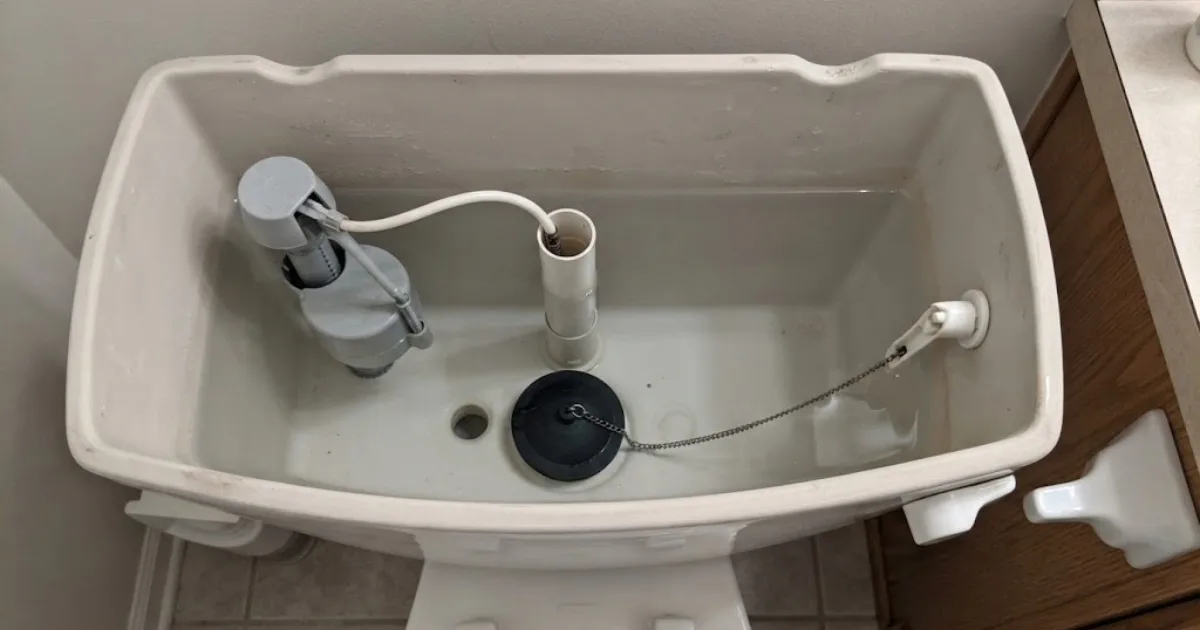
The most likely cause, by far
A flapper valve that isn't sealing properly against the flush valve seat is responsible for the vast majority of running toilets. The flapper is the rubber or plastic piece at the bottom of the tank that lifts when the toilet is flushed and should drop back down to seal the tank. Over time, it warps, cracks, or accumulates mineral deposits that prevent a full seal, and water slowly leaks from the tank into the bowl continuously.
How to confirm it's actually the flapper
Remove the tank lid and watch what happens after a flush completes. If the flapper visibly doesn't sit flat against the seat, or if you can hear or see water trickling into the bowl a minute or more after flushing with no one touching the toilet, that confirms the flapper is the issue. A dye test, adding a few drops of food coloring to the tank and checking if color appears in the bowl without flushing, is another reliable way to confirm a seal problem.
Other, less common causes worth ruling out
A fill valve that doesn't shut off completely once the tank reaches its target level is the second most common cause, usually recognizable by water continuously trickling into the overflow tube rather than stopping at the right level. A float that's set too high, causing water to constantly spill into the overflow tube, is a related and even simpler fix, sometimes just an adjustment rather than a parts replacement.
Why this is worth fixing promptly, even though it's not an emergency
A continuously running toilet can waste hundreds of gallons of water a day, which shows up clearly on the next water bill even though the toilet itself never overflows or causes visible damage. It's exactly the kind of issue that's easy to ignore because nothing looks wrong, right up until the bill arrives.
When it's worth calling rather than fixing it yourself
A flapper or fill valve replacement is a manageable task for many homeowners comfortable with basic tools, and parts are inexpensive at any hardware store. It's worth calling a professional if the issue persists after replacing the obvious parts, if the toilet is old enough that parts are hard to match, or simply if it's not something you want to deal with yourself.
A note on older toilets and mineral buildup
On a toilet more than 15 years old, mineral deposits inside the fill valve and flapper mechanism can make even a freshly replaced part fail sooner than expected, since the surrounding components are also degraded. If a running toilet keeps recurring even after replacing the obvious parts, the fill valve assembly as a whole, not just the flapper, may need replacement rather than continuing to swap individual pieces.
A note on toilets in guest bathrooms and less-used spaces
A toilet in a guest bathroom or other infrequently used space can develop a running issue that goes unnoticed for a long time simply because no one is around to hear it. Periodically checking less-used bathrooms, even just listening for a minute near the toilet, catches this kind of hidden waste before it accumulates into a genuinely large amount on the water bill.
What a running toilet costs in Pompano Beach
The City of Pompano Beach says a leaking toilet can waste thousands of gallons a month, and that fixing leaks can reduce both water and sewer charges. A toilet that runs for hours is one of the cheapest leaks to stop.
If the flapper and fill valve look fine and the meter still moves, use the City's test. Take a reading, use no water for an hour, and read again. A changed number means water is still going somewhere else.
We also send technicians to Margate and Lighthouse Point. See our Margate plumber and Lighthouse Point plumber pages for details on those areas.